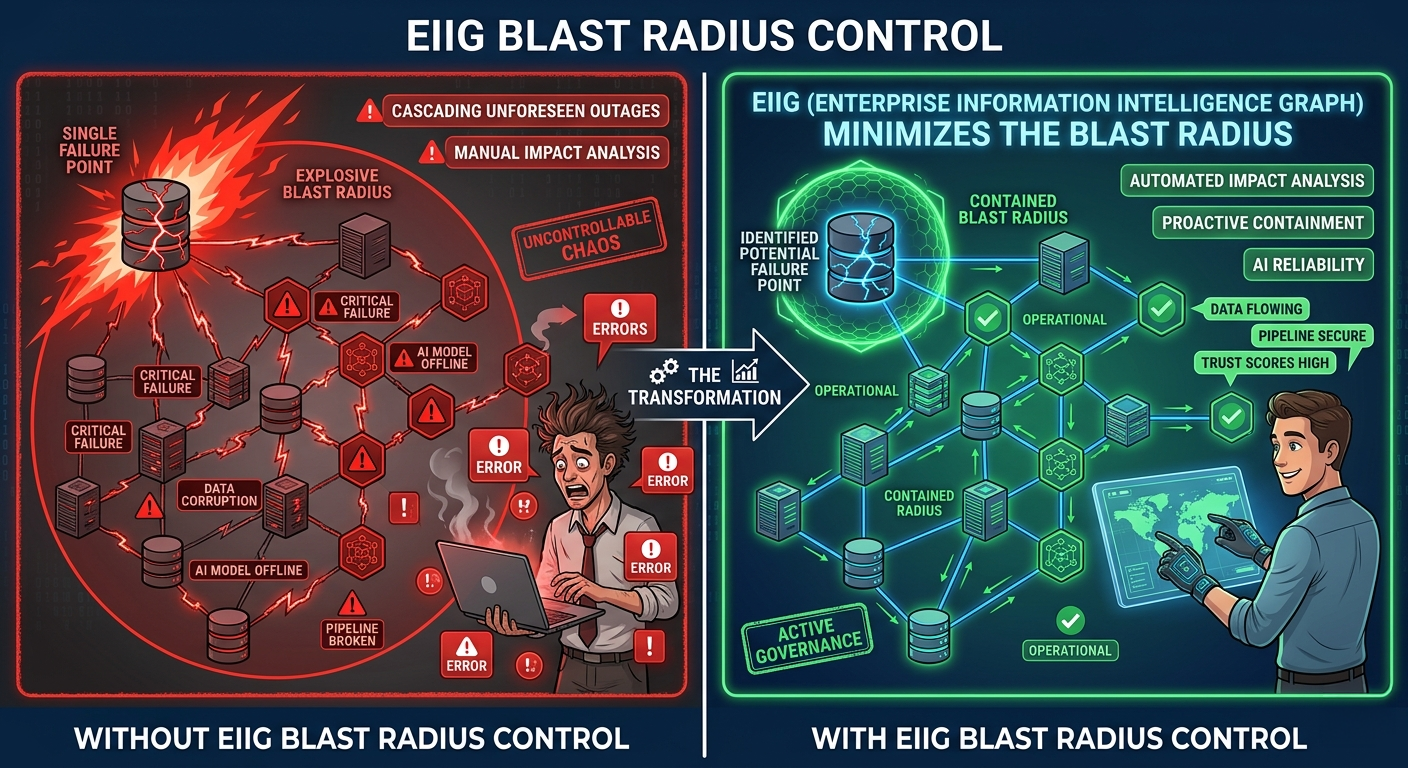
In modern enterprises, data ecosystems have become deeply interconnected across cloud platforms, AI pipelines, analytics tools, legacy systems, and regulatory reporting environments. In this landscape, a single unmanaged change—a schema modification, corrupted dataset, failed pipeline, or exposed credential—can rapidly cascade across downstream systems.
This cascading scope of operational, analytical, security, or compliance impact is commonly referred to as the blast radius.
In the context of data and AI governance, blast radius measures how far-reaching the consequences of a failure, quality issue, security breach, or metadata change can spread throughout the enterprise. Understanding and controlling blast radius is now essential for ensuring trusted AI, resilient analytics, regulatory compliance, and operational stability.
Orion Governance’s Enterprise Information Intelligence Graph (EIIG) was specifically designed to calculate, visualize, and minimize this blast radius across the modern enterprise data landscape.
By building a self-defined data fabric from the “DNA level” upward, EIIG transforms metadata into an active intelligence layer that continuously maps dependencies, monitors changes, and exposes downstream impacts in near real time.
Why Blast Radius Matters in Modern Data and AI Governance
Traditional data governance approaches often rely on static documentation, manual lineage mapping, and reactive troubleshooting. In highly distributed architectures, these methods are no longer sufficient.
Several factors determine the size and severity of a blast radius:
Data Criticality
The more essential a dataset is to business operations—such as customer PII, financial records, risk calculations, or regulatory submissions—the greater the operational and compliance impact if it becomes compromised or inaccurate.
Data Lineage Complexity
Modern data architectures contain extensive downstream dependencies. A single upstream table may feed hundreds of dashboards, machine learning models, reports, APIs, and operational systems. Without visibility into these relationships, organizations cannot accurately assess impact before changes occur.
Integration Density
Cloud ecosystems such as Snowflake, Databricks, Hadoop, mainframes, SaaS platforms, and AI pipelines are tightly interconnected. Failures within one node can propagate rapidly through the broader metadata ecosystem.
User and Application Dependency
The number of analysts, business users, AI models, or customer-facing applications relying on a dataset directly amplifies the blast radius of outages or corruption.
Because of these realities, governance teams need active intelligence—not passive documentation—to understand how risks propagate through the enterprise.
How EIIG Calculates and Controls Blast Radius
1. Automated, Granular Impact Analysis
One of the first questions organizations ask after a schema change or pipeline failure is:
“What breaks downstream?”
EIIG answers this instantly.
EIIG ingests metadata from more than 70 legacy and modern technologies and stitches them together into an interconnected enterprise intelligence graph. By selecting any dataset, pipeline, column, report, API, or AI asset, users can execute automated impact analysis within seconds.
This enables organizations to:
- Visualize downstream dependencies
- Identify affected reports, dashboards, and applications
- Detect vulnerable AI models
- Assess operational and compliance exposure
- Simulate changes before deployment
Instead of relying on manual tribal knowledge, engineering and governance teams gain precise visibility into the entire blast radius of a proposed change.
Governance Benefits
- Reduces the risk of cascading system outages
- Eliminates “fear of change” in DevOps and data operations
- Prevents corrupted data from reaching business users
- Enables proactive containment before failures spread
2. Protecting AI Pipelines Through Lineage Intelligence
AI systems are particularly vulnerable to silent upstream data issues.
A small change in source data can lead to:
- Model hallucinations
- Drifted predictions
- Biased outputs
- Failed ML pipelines
- Regulatory exposure
EIIG provides end-to-end lineage visibility across:
- Python-based AI pipelines
- Machine learning workflows
- Mainframes
- Relational databases
- Cloud platforms such as Snowflake and Databricks
- BI and analytics environments
By extracting metadata directly from source code repositories and operational systems—without impacting production workloads—EIIG traces both horizontal and vertical lineage throughout the enterprise.
Governance Benefits
If an AI model begins producing anomalous outputs, teams can trace backward to identify the precise upstream root cause.
Conversely, if a source dataset is compromised, EIIG can trace forward to determine:
- Which AI models are affected
- Which business processes rely on those models
- Which downstream consumers fall within the blast radius
- Which models must be retrained, isolated, or temporarily disabled
This creates a trusted governance framework for explainable and reliable AI.
3. Active Metadata and Real-Time Change Alerting
Traditional governance often becomes outdated immediately after documentation is created.
EIIG shifts governance from passive documentation to active operational intelligence.
Using near real-time metadata monitoring, EIIG continuously detects:
- Schema modifications
- Structural changes
- Metadata updates
- Pipeline disruptions
- Lineage changes
- Sensitive data movement
Users can subscribe to critical data assets and receive automated alerts whenever changes occur.
Governance Benefits
The moment a change enters the ecosystem:
- Data stewards are notified
- Developers receive impact visibility
- Model owners see downstream exposure
- Governance teams obtain a visual map of the blast radius
This enables organizations to isolate issues before they disrupt downstream systems, analytics, or AI operations.
4. Reducing Regulatory and Security Blast Radius
In highly regulated industries such as banking, healthcare, insurance, and government, the blast radius of a data incident extends beyond operational downtime.
It may include:
- Regulatory violations
- Audit failures
- Financial penalties
- Reputational damage
- Security exposure
EIIG minimizes this risk through active metadata propagation and intelligence graph analysis.
The platform automatically propagates:
- Sensitive data classifications (PII, PHI, financial data)
- Trust scores
- Quality metrics
- Compliance metadata
- Governance policies
across the entire enterprise information supply chain.
Governance Benefits
If a security issue is detected—such as a compromised credential or exposed cloud bucket—EIIG can immediately determine:
- Which datasets were exposed
- Which downstream environments consumed the data
- Which reports or regulatory filings were affected
- Which applications or AI models are impacted
Rather than guessing how far exposure spread, organizations receive a precise compliance blast radius assessment.
This capability is especially valuable for:
- BCBS 239 compliance
- GDPR governance
- HIPAA environments
- AI governance frameworks
- Enterprise audit readiness
Mitigating Blast Radius Through Active Governance
Organizations seeking to reduce operational and AI risk increasingly focus on three foundational governance capabilities:
Active Metadata Management
Using EIIG to continuously map lineage, dependencies, ownership, and transformations across the enterprise.
Data Observability
Implementing near real-time monitoring and push-based alerts to detect anomalies before they spread.
Governance Guardrails
Enforcing automated validation, schema governance, stewardship workflows, and policy-driven controls before changes propagate downstream.
By identifying high-impact nodes within the architecture, governance teams can apply stronger controls precisely where failures would be most catastrophic.
Summary of Business Impact
| Governance Area | Without EIIG Blast Radius Controls | With EIIG Active Intelligence Graph |
|---|---|---|
| Change Management | Manual impact analysis with high risk of cascading outages | Automated impact analysis within seconds |
| AI Reliability | Silent data corruption causes unreliable model outputs | Lineage-driven tracing and AI protection |
| Incident Response | Slow root-cause investigation across siloed systems | Immediate visibility into downstream impact |
| Audit & Compliance | Manual lineage tracing and audit preparation | Near real-time lineage and compliance visibility |
| Security Governance | Uncertain scope of data exposure | Precise identification of affected systems and assets |
| Operational Resilience | Reactive troubleshooting after failures occur | Proactive containment and governance automation |
Conclusion
As enterprises accelerate AI adoption and modernize their data ecosystems, understanding blast radius is no longer optional—it is foundational to effective governance.
Orion Governance’s EIIG transforms metadata into an active intelligence system capable of:
- Calculating blast radius in real time
- Visualizing enterprise-wide dependencies
- Protecting AI reliability
- Automating governance operations
- Reducing regulatory and operational risk
By providing deep lineage visibility and active metadata intelligence, EIIG ensures that a spark in one corner of the enterprise does not become an uncontrolled explosion across the entire data and AI ecosystem.
recent posts
Simplifying Life for Data Engineers
A data engineer benefits from Orion Governance's Enterprise Information Intelligence Graph (EIIG) because it does much more than catalog [...]
Empowering Cloud Architects to Accelerate Their Data Modernization/Cloud Migration Projects
For a cloud architect, one of the greatest challenges in data modernization isn't moving data—it's understanding what should be [...]
What Every Chief Data & Analytics Officer Needs
A Chief Data & Analytics Officer (CDAO) has one of the most challenging roles in the enterprise. They are expected [...]
Orion’s Enterprise Information Intelligence Graph Enables the Chief AI Officer to Ensure the Success of AI Initiatives
A Chief AI Officer (CAIO) is ultimately accountable for ensuring that AI initiatives deliver measurable business value while remaining [...]
Orion Governance’s Enterprise Information Intelligence Graph (EIIG) Fast-tracks AI Audit Readiness
AI audit readiness means an organization can demonstrate—not merely claim—that its AI systems are built on trusted data, governed [...]
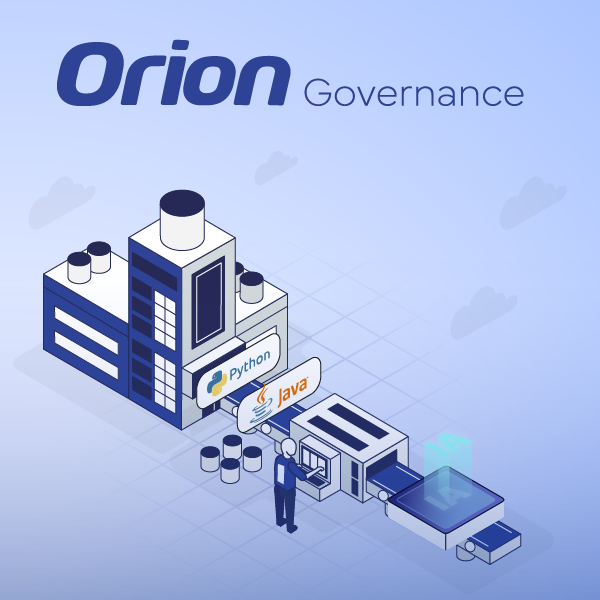
How Orion’s Enterprise Information Intelligence Graph (EIIG) Transforms Python and Java into Trusted Data for AI
Many data governance platforms claim support for Python and Java, but their capabilities often end with cataloging code repositories [...]