Cloud migrations are often framed as a technical exercise — move systems, modernize platforms, decommission legacy tools. But the real risk (and real value) of a migration lives in the data and how it’s used across the organization. That’s where data lineage and impact analysis become critical!
-
Lineage creates trust in the migration
Data lineage shows where data originates, how it’s transformed, and where it’s consumed. During a migration, this visibility helps teams:
- Understand which source systems feed critical reports and applications
- Validate that business logic is preserved in the target environment
- Prove data accuracy to stakeholders, auditors, and regulators
-
Impact analysis prevents expensive surprises
Changing or decommissioning a system rarely affects just one application. Impact analysis answers the hard questions upfront:
- Which downstream reports, interfaces, and processes will break if a table or field changes?
- What business functions are at risk if a migration step is delayed or altered?
- Which dependencies must be migrated together to avoid outages?
-
Better prioritization and sequencing
Lineage and impact analysis help migration teams:
- Identify high-value and high-risk data flows
- Group related systems and datasets for logical migration waves
- Avoid migrating “dead” data while protecting what matters!
-
Stronger governance post-migration
A migration is also an opportunity to improve data governance. Documented lineage and impact mappings:
- Support compliance and audit requirements
- Enable new teams to understand the environment without starting from scratch
Successful Cloud migrations aren’t just about moving technology — they’re about preserving business meaning and minimizing risk. Data lineage and impact analysis turn a complex migration into a controlled, transparent, and business-aligned transformation.
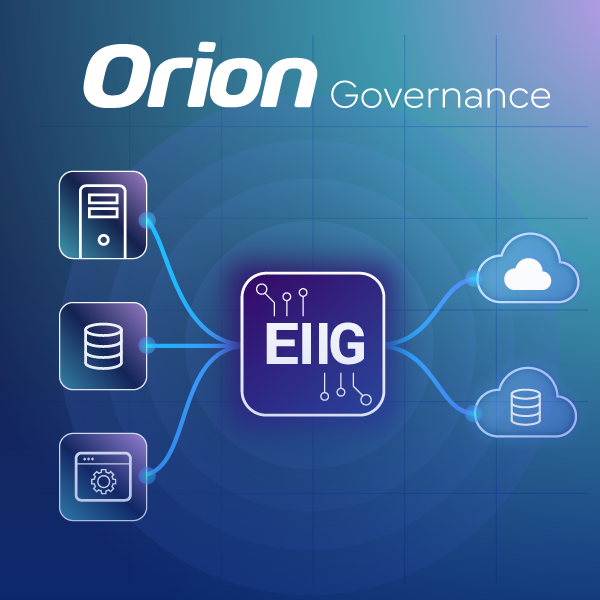
With Orion Enterprise information Intelligence Graph (EIIG) you will get a near real-time knowledge graph by just ingesting the metadata from the relevant systems! This leads to faster timelines and smarter use of resources. You will reduce the rework, production incidents, and avoid last-minute fire drills. When you use EIIG in your migration, the team can accelerate the project as they don’t have to rely on tribal knowledge, you will have access to a fact-based always updated map of your data landscape at your fingertips!
About the Author: Rolf Rosell is the Director of Global Sales at Orion Governance. You may connect with him in LinkedIn. https://www.linkedin.com/in/rolf-rosell-758abaa/
recent posts
From Compliance Silos to Compliance Intelligence in the Age of AI
For Chief Compliance Officers, the challenge is no longer simply keeping up with regulations. The greater challenge is that regulations [...]
Maximizing Data Steward Efficiency
A data steward is responsible for ensuring that enterprise data is accurate, well-defined, trusted, and compliant. Much of their [...]
Simplifying Life for Data Engineers
A data engineer benefits from Orion Governance's Enterprise Information Intelligence Graph (EIIG) because it does much more than catalog [...]
Empowering Cloud Architects to Accelerate Their Data Modernization/Cloud Migration Projects
For a cloud architect, one of the greatest challenges in data modernization isn't moving data—it's understanding what should be [...]
What Every Chief Data & Analytics Officer Needs
A Chief Data & Analytics Officer (CDAO) has one of the most challenging roles in the enterprise. They are expected [...]
Orion’s Enterprise Information Intelligence Graph Enables the Chief AI Officer to Ensure the Success of AI Initiatives
A Chief AI Officer (CAIO) is ultimately accountable for ensuring that AI initiatives deliver measurable business value while remaining [...]