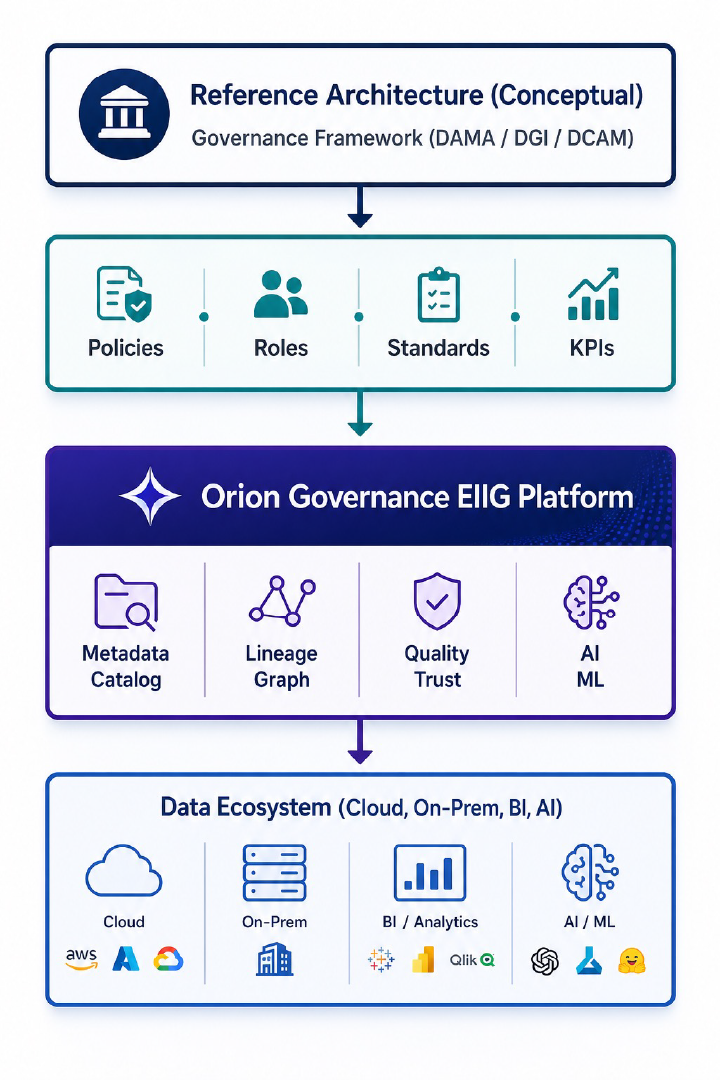
To use Orion Governance Enterprise Information Intelligence Graph (EIIG) effectively, you shouldn’t treat it as “just a tool.” It works best when it is anchored to a formal data governance framework and used to operationalize best practices across people, process, and technology.
Below is a practical, implementation-oriented view that connects EIIG → governance framework → execution steps → best practices.
EIIG aligns naturally with widely used frameworks such as:
- DAMA International (DMBOK)
- Data Governance Institute (DGI)
- EDM Council (DCAM)
Core governance domains (framework layer)
Most frameworks converge on:
- Data ownership & stewardship
- Data quality management
- Metadata management
- Data lineage & transparency
- Data security & compliance
- Data lifecycle management
EIIG doesn’t replace the framework—it implements and automates it.
2) Map EIIG Capabilities to Governance Domains
| Governance Domain | EIIG Capability | Outcome |
|---|---|---|
| Metadata Management | Automated catalog + knowledge graph | Single source of truth |
| Data Lineage | End-to-end lineage, field-level traceability | Auditability & impact analysis |
| Data Quality | Profiling, rules, quality scoring | Trusted data |
| Stewardship | Business glossary + ownership tagging | Accountability |
| Security & Compliance | Policy mapping + lineage-based controls | Regulatory alignment |
| Data Lifecycle | Change detection + usage analytics | Controlled evolution |
EIIG acts as the execution engine behind the governance model.
3) Step-by-Step: Implement Data Governance with EIIG
Step 1: Define Governance Operating Model
- Identify:
- Data owners
- Data stewards
- Governance council
- Define policies:
- Naming standards
- Data quality thresholds
- Access rules
Best practice: Start with critical data domains (e.g., customer, finance).
Step 2: Connect and Ingest Metadata
- Use EIIG ingestors to ingest:
- Databases and Data Warehouses both on-prem and on cloud
- ETL/ELT pipelines
- BI tools
- Programming Languages (Python, Java, Scala, COBOL, JCL etc.)
- Create a map of end-to-end enterprise information flow
Outcome:
- Automated inventory of all data assets
- Elimination of “unknown data”
Step 3: Establish Data Catalog & Business Glossary
- Establish:
- Business terms (e.g., “Customer,” “Revenue”)
- Definitions and policies
- Automatically link business terms to physical data assets via ML-enabled mapper
Best practice: Start with the facts of the data assets, but govern at business term level, not just technical metadata
Step 4: Enable End-to-End Data Lineage
- Auto-generate lineage across:
- Source systems
- Transformations
- Reports
Use it to:
- Validate data flows
- Support audits
- Perform impact analysis
This is critical for regulatory compliance and AI explainability.
Step 5: Implement Data Quality Governance
- Use EIIG profiling to:
- Detect anomalies
- Measure completeness, accuracy, consistency
- Define rules:
- Thresholds (e.g., null rate < 2%)
- Assign ownership for remediation
Best practice: Tie data quality rules to business impact, not just technical checks.
Step 6: Apply Similarity Analysis & Deduplication
- Use EIIG’s: Structural similarity (metadata-level) and Data-level similarity (profiling + content) to:
- Identify duplicate datasets
- Rationalize redundant pipelines
Outcome:
- Reduced data sprawl
- Lower storage and processing cost
- Improved trust
Step 7: Activate Policy & Compliance Controls
- Map policies to:
- Data elements
- Lineage paths
Examples:
- GDPR: track PII across systems
- Financial reporting: ensure traceability
EIIG enables policy enforcement through visibility + lineage.
Step 8: Operationalize Governance (Active Metadata)
- Enable:
- Real-time change detection
- Alerts when schema/pipeline changes occur
- Trigger workflows:
- Steward review
- Impact assessment
Best practice: Move from passive governance → active governance.
Step 9: Measure & Improve Governance
Track KPIs such as:
- Data quality scores
- Data trust scores
- Number of certified data assets
- Impact analysis
EIIG provides metadata analytics for continuous monitoring and improvement.
4) How EIIG Supports Data Governance Best Practices
- “Fact-based, Business-relevant governance”
- Adopts the bottom-up approach to start with the evidence of the data assets
- Links business glossary ↔ technical metadata
- Prevents purely IT-driven governance
- “Automate wherever possible”
- Auto-lineage, auto-catalog, ML-driven classification
- Reduces manual stewardship burden
- “Govern by exception”
- Focus on anomalies detected via profiling and change detection
- Avoids over-governance
- “End-to-end visibility”
- Detailed lineage connects:
- Data → pipelines → reports across different systems
- “Trust as a measurable outcome”
- EIIG introduces:
- Data trust scores
- Quality metrics
- Usage-based validation
- “Shift-left governance”
- Integrate governance into:
- Data pipelines
- Data product lifecycle
5) What Makes EIIG Different in Governance
Compared to traditional tools, EIIG emphasizes:
- Starting with a bottom-up approach → evidence-based governance
- Business-relevant → mapping business terms with technical assets
- Truly end-to-end enterprise data lineage → living and breathing map of enterprise information flow
- Real-time impact analysis and change detection → Proactive change management
- Contextualized graph architecture → deeper relationships and actionable insight
- Active metadata → real-time governance
- Integrated similarity analysis → eliminates redundancy
- Tight coupling of real-time data quality + metadata → stronger trust
recent posts
From Compliance Silos to Compliance Intelligence in the Age of AI
For Chief Compliance Officers, the challenge is no longer simply keeping up with regulations. The greater challenge is that regulations [...]
Maximizing Data Steward Efficiency
A data steward is responsible for ensuring that enterprise data is accurate, well-defined, trusted, and compliant. Much of their [...]
Simplifying Life for Data Engineers
A data engineer benefits from Orion Governance's Enterprise Information Intelligence Graph (EIIG) because it does much more than catalog [...]
Empowering Cloud Architects to Accelerate Their Data Modernization/Cloud Migration Projects
For a cloud architect, one of the greatest challenges in data modernization isn't moving data—it's understanding what should be [...]
What Every Chief Data & Analytics Officer Needs
A Chief Data & Analytics Officer (CDAO) has one of the most challenging roles in the enterprise. They are expected [...]
Orion’s Enterprise Information Intelligence Graph Enables the Chief AI Officer to Ensure the Success of AI Initiatives
A Chief AI Officer (CAIO) is ultimately accountable for ensuring that AI initiatives deliver measurable business value while remaining [...]