Cloud migrations are often framed as a technical exercise — move systems, modernize platforms, decommission legacy tools. But the real risk (and real value) of a migration lives in the data and how it’s used across the organization. That’s where data lineage and impact analysis become critical!
-
Lineage creates trust in the migration
Data lineage shows where data originates, how it’s transformed, and where it’s consumed. During a migration, this visibility helps teams:
- Understand which source systems feed critical reports and applications
- Validate that business logic is preserved in the target environment
- Prove data accuracy to stakeholders, auditors, and regulators
-
Impact analysis prevents expensive surprises
Changing or decommissioning a system rarely affects just one application. Impact analysis answers the hard questions upfront:
- Which downstream reports, interfaces, and processes will break if a table or field changes?
- What business functions are at risk if a migration step is delayed or altered?
- Which dependencies must be migrated together to avoid outages?
-
Better prioritization and sequencing
Lineage and impact analysis help migration teams:
- Identify high-value and high-risk data flows
- Group related systems and datasets for logical migration waves
- Avoid migrating “dead” data while protecting what matters!
-
Stronger governance post-migration
A migration is also an opportunity to improve data governance. Documented lineage and impact mappings:
- Support compliance and audit requirements
- Enable new teams to understand the environment without starting from scratch
Successful Cloud migrations aren’t just about moving technology — they’re about preserving business meaning and minimizing risk. Data lineage and impact analysis turn a complex migration into a controlled, transparent, and business-aligned transformation.
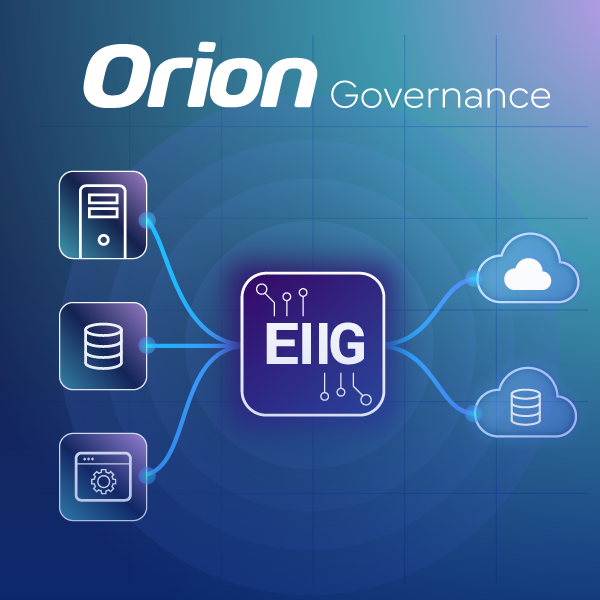
With Orion Enterprise information Intelligence Graph (EIIG) you will get a near real-time knowledge graph by just ingesting the metadata from the relevant systems! This leads to faster timelines and smarter use of resources. You will reduce the rework, production incidents, and avoid last-minute fire drills. When you use EIIG in your migration, the team can accelerate the project as they don’t have to rely on tribal knowledge, you will have access to a fact-based always updated map of your data landscape at your fingertips!
About the Author: Rolf Rosell is the Director of Global Sales at Orion Governance. You may connect with him in LinkedIn. https://www.linkedin.com/in/rolf-rosell-758abaa/
recent posts
Is Duplicate Data Silently Draining Your IT Budget?
Data redundancy isn't just a storage issue—it's a governance, risk, and cost challenge. At Orion Governance, the Enterprise Information [...]
How Orion Governance’s Enterprise Information Intelligence Graph (EIIG) Helps Banks to Meet BCBS 239 Requirements
Orion Governance’s EIIG can help banks meet all 11 BCBS 239 principles that apply to governance/infrastructure, risk data aggregation, [...]

Leverage Orion Governance’s end-to-end data lineage for BCBS 239 Compliance
Kick off the year by using Orion Governance to map end-to-end, auditable data lineage that helps banking teams demonstrate [...]
Accelerate the Delivery of Trusted, AI-Ready Data: Reflections from the Gartner Chicago CDAO Executive Summit
The Gartner Chicago CDAO Executive SummitThe Gartner Chicago CDAO Executive Summit, held at the architecturally stunning Convene in the iconic [...]

Orion Governance Announces SOC 2 Type II Certification
Announcing SOC 2 Type II Certification: Orion Governance's Continuing Commitment to Excellence in Security and Trust We are thrilled [...]


A Solution to Solving the Stubborn Data Silo Problem | Evanta NYC 2024 Review
Thank you to Evanta for organizing this CDAO Executive Summit in New York, where leaders in digital transformation shared [...]