Why do organizations change data catalog vendors? Take a look at some of the top reasons a change in vendors is needed.
- Change in leadership: The new leader could possess a wealth of expertise from working with alternative data catalogs, or perhaps they have encountered challenges while utilizing the same data catalog in various organizations.
- A package deal from a big vendor: The core data management capabilities of the organization are undergoing a significant transformation, with the introduction of a new vendor who offers a bundled product that includes a data catalog. It is worth noting that the leadership may not possess a comprehensive understanding of the intricacies involved in this exciting change.
- Lower adoptions: The product was launched, but unfortunately, it hasn’t gained as much traction as anticipated. The leader in charge struggled to handle the complex changes required for adoption. Additionally, a considerable number of mid-level managers exhibited minimal involvement in the implementation procedure.
- Product implementation lifecycle: The process of bringing the product to go live is quite time-consuming, and there are numerous customizations required to meet the business requirements. Additionally, it poses a significant challenge for the team to maintain it. Furthermore, upon rolling out to multiple functional areas, legal entities, and geographical regions, it has been discovered that the data catalog is unable to handle the complexities.
- Usage life cycle: The product has been in use by end users for a considerable period of time, and as a result, they have gained a comprehensive understanding of its limitations and areas for improvement. Furthermore, despite providing detailed explanations of user grievances, the Vendor has failed to deliver any of the promised advanced features.
- Meet the demand: The vendor was repeatedly requested to enhance the product in order to align with specific business requirements. However, the vendor’s response time was considerably lengthy in meeting these demands. In certain instances, the vendor could only partially fulfill the stipulated requirements or failed to deliver the promised changes as requested.
- Competitive advantage: All peer organizations are currently utilizing the identical product, prompting the desire to transition towards a contemporary catalog that offers enhanced capabilities in order to attain a competitive advantage.
- Lack of required resources: To ensure the content remains vibrant and dynamic, numerous manual activities are required. However, regrettably, there is a scarcity of allocated resources to carry out these essential tasks. It hinders progress, restricts innovation, and limits the ability to meet the needs and demands.
Does your organization need to change data catalog vendors? Schedule a demo to learn more about EIIG’s data catalog capabilities.
About the Author: Ram Pratti is the Chief Evangelist at Orion Governance, Inc. Connect with Ram on LinkedIn.
recent posts
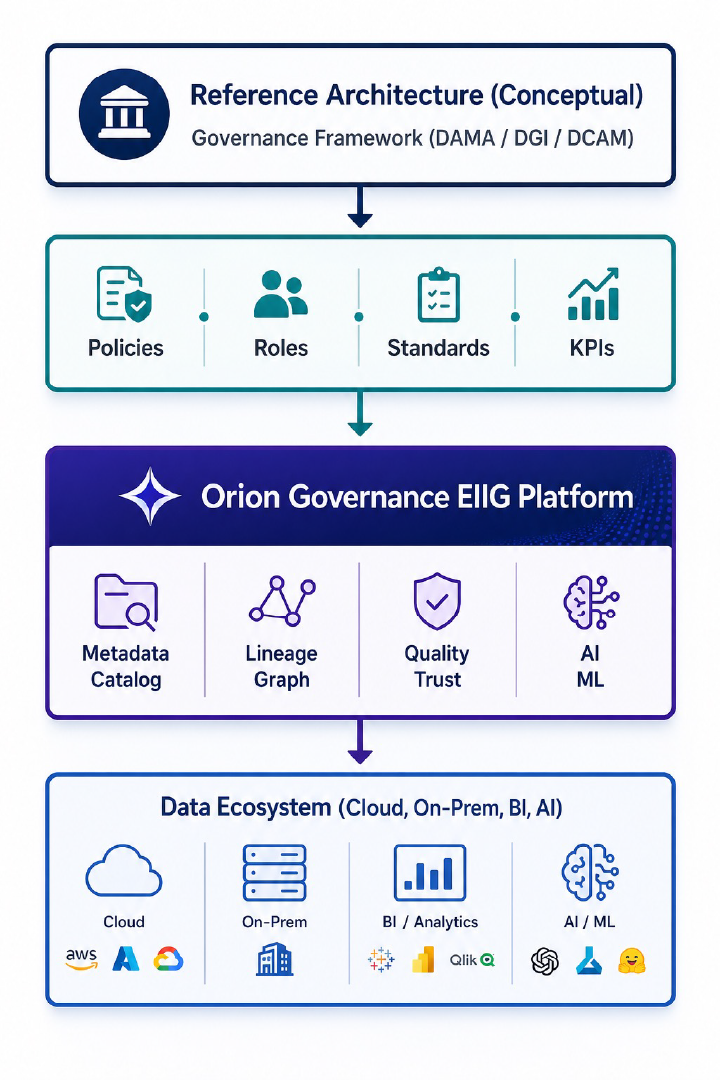
How to Leverage Orion Governance Enterprise Information Intelligence Graph to Implement Data Governance Framework
To use Orion Governance Enterprise Information Intelligence Graph (EIIG) effectively, you shouldn’t treat it as “just a tool.” It [...]
Orion Governance Enterprise Information Intelligence Graph Data Quality Baseline Report
A Data Quality (DQ) Baseline Report acts as the "health check" of your data before any remediation begins. In [...]

From Data Lineage to Enterprise Intelligence Fabric
Orion Governance’s Enterprise Information Intelligence Graph (EIIG) offers the definitive data lineage solution: automated, comprehensive, granular, multi-layered, and collaborative. [...]
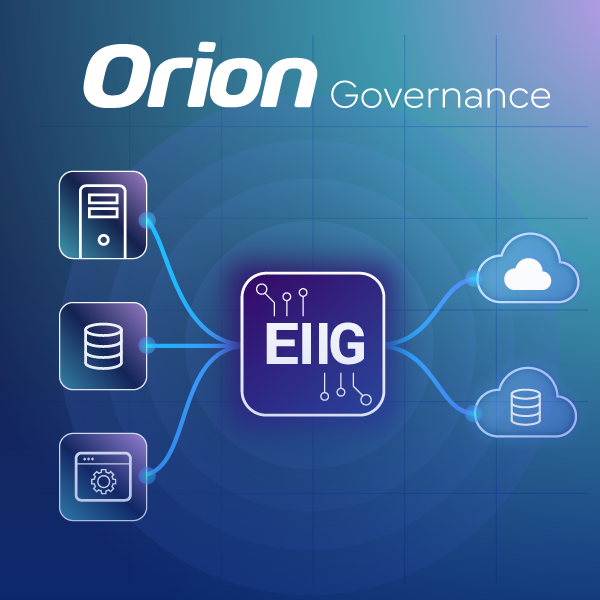
The Benefits of Using Orion Enterprise Information Intelligence Graph to Accelerate Cloud Migration/ Modernization
Cloud migrations are often framed as a technical exercise — move systems, modernize platforms, decommission legacy tools. But the [...]
Is Duplicate Data Silently Draining Your IT Budget?
Data redundancy isn't just a storage issue—it's a governance, risk, and cost challenge. At Orion Governance, the Enterprise Information [...]
How Orion Governance’s Enterprise Information Intelligence Graph (EIIG) Helps Banks to Meet BCBS 239 Requirements
Orion Governance’s EIIG can help banks meet all 11 BCBS 239 principles that apply to governance/infrastructure, risk data aggregation, [...]