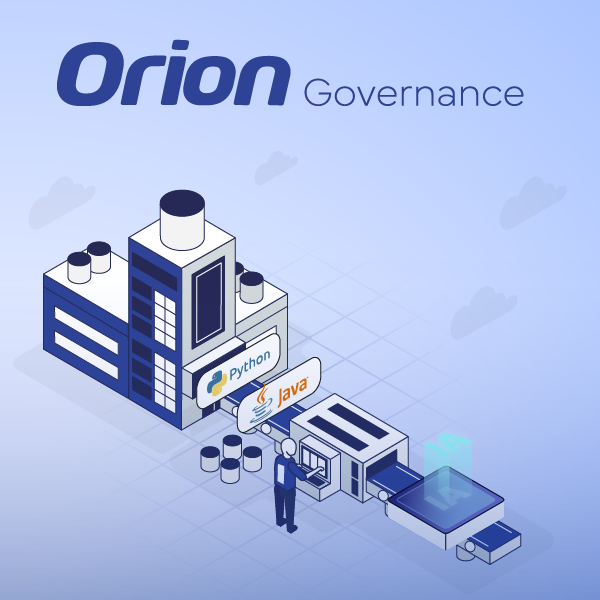
Many data governance platforms claim support for Python and Java, but their capabilities often end with cataloging code repositories or application assets. Orion Enterprise Information Intelligence Graph (EIIG) takes a fundamentally different approach. Rather than simply identifying Python and Java applications, EIIG understands how they create, transform, validate, and consume enterprise data, integrating this intelligence into a unified AI Data Fabric. By extending end-to-end lineage through application code—not just databases and ETL pipelines—EIIG eliminates critical blind spots in the AI data supply chain. The result is complete transparency into how data is created, transformed, and delivered to AI models, giving organizations confidence that their AI is built on trusted, governed, and fully traceable data while providing the explainability needed for regulatory compliance and responsible AI.
AI models are only as reliable as the data that feeds them. While most governance solutions provide visibility into databases or ETL pipelines, AI data often flows through Python notebooks, Java microservices, APIs, feature engineering pipelines, and custom business logic before it reaches a model. Without understanding these components, organizations are left with blind spots that undermine AI transparency and trust.
Orion EIIG automatically parses Python and Java applications and integrates them into a knowledge graph, creating continuous end-to-end lineage across databases, SQL, ETL processes, APIs, application code, machine learning pipelines, and BI platforms. Every transformation, calculation, and data movement can be traced from its original source to the AI model and ultimately to the business decision.
This comprehensive visibility enables organizations to:
- Verify the provenance of every dataset used for AI training and inference.
- Detect where Python or Java logic alters, enriches, filters, or aggregates data before it reaches AI models.
- Identify data quality issues, policy violations, or sensitive data exposure anywhere along the AI data supply chain.
- Perform rapid impact analysis when application code, business rules, or source data changes.
- Provide auditors, regulators, and business stakeholders with complete evidence of how AI outputs were produced.
- Establish confidence that AI decisions are based on accurate, governed, and trusted enterprise data.
Unlike traditional metadata catalogs that primarily inventory code repositories or document data assets, Orion EIIG transforms Python and Java applications into first-class citizens of the enterprise metadata ecosystem. By combining real-time data profiling, data quality analysis, metadata management, and end-to-end lineage within a unified AI Data Fabric, EIIG closes the gap between application development and data governance.
The result is a continuous transparency path that enables organizations to trust not only where their AI data originated, but also how it was processed, validated, and governed throughout its entire lifecycle. This level of visibility is fundamental to delivering explainable, compliant, and trustworthy AI at enterprise scale.
recent posts

From Risk Models to Risk Intelligence: Rethinking Risk Management in the Age of AI
For decades, risk management has relied on models to quantify uncertainty, estimate exposure, and support better decisions. Credit risk, [...]
From Compliance Silos to Compliance Intelligence in the Age of AI
For Chief Compliance Officers, the challenge is no longer simply keeping up with regulations. The greater challenge is that regulations [...]
Maximizing Data Steward Efficiency
A data steward is responsible for ensuring that enterprise data is accurate, well-defined, trusted, and compliant. Much of their [...]
Simplifying Life for Data Engineers
A data engineer benefits from Orion Governance's Enterprise Information Intelligence Graph (EIIG) because it does much more than catalog [...]
Empowering Cloud Architects to Accelerate Their Data Modernization/Cloud Migration Projects
For a cloud architect, one of the greatest challenges in data modernization isn't moving data—it's understanding what should be [...]
What Every Chief Data & Analytics Officer Needs
A Chief Data & Analytics Officer (CDAO) has one of the most challenging roles in the enterprise. They are expected [...]